
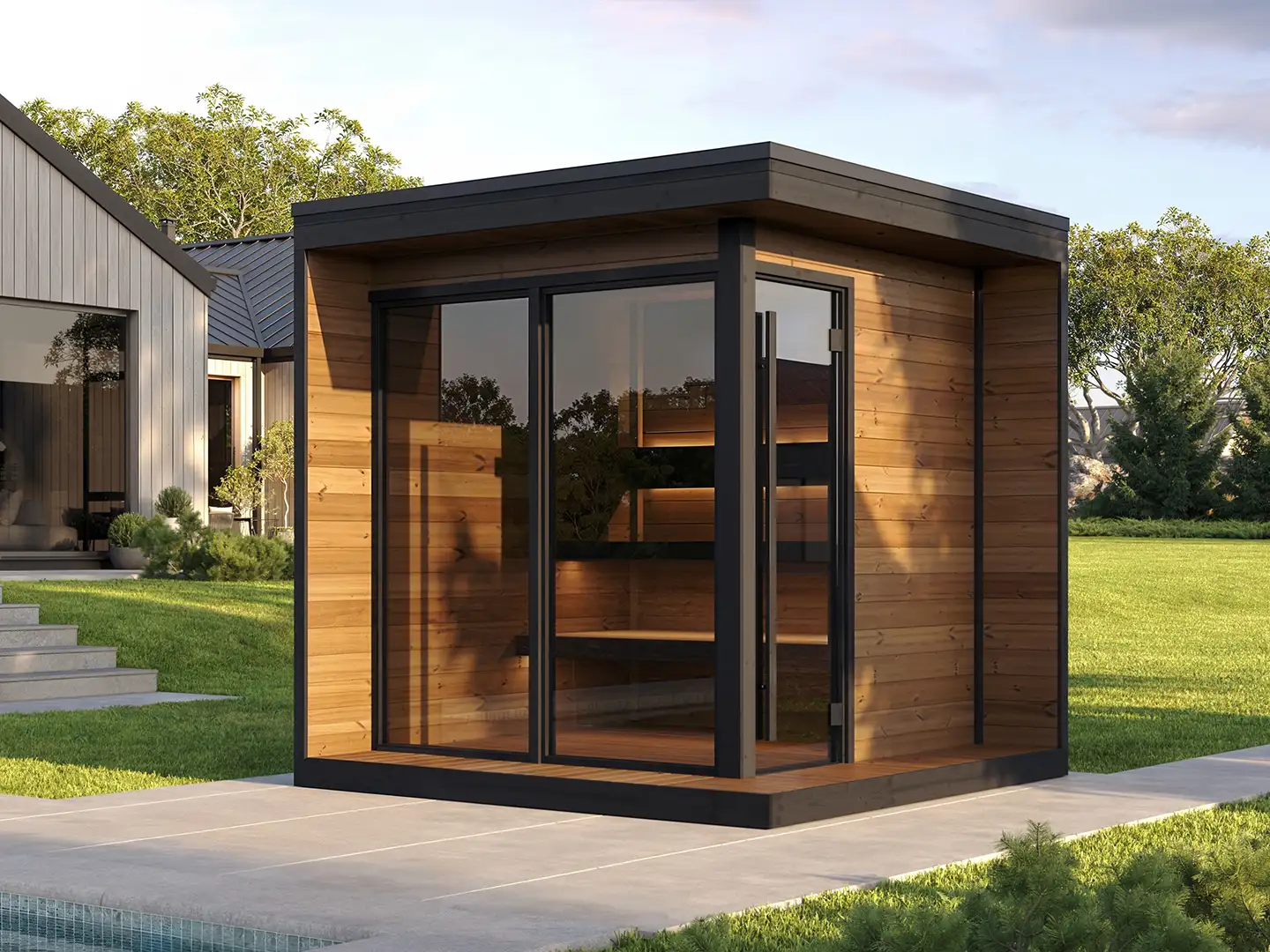
When we talk about a sauna in this country, it is usually the type of sauna that has its origins in Finnish: a small room or building designed for taking a dry or steamy “bath” in very hot air. This type of sauna has a long history, and although the word sauna comes from Finnish, the sauna itself has been used all over the world since man learned to build.
All over the world you can find variations of “sweat lodges”, where different peoples have exploited the benefits of sweating thoroughly and at the same time getting the benefit of the heat that the body absorbs. The Indians in the highlands of Central America called the sauna temazcal. Archaeological finds in Greenland and Newfoundland show that saunas were used very similar to those in northern Europe. In Europe, it is the Nordic countries that are known for their saunas, which makes good sense in countries with harsh winter climates.
If you want to know more about the health benefits of saunas, we recommend that you read the article here.
Modern saunas
Modern saunas are usually made of wood. Our saunas reach the temperature expected in a sauna. High temperatures require control of the humidity in order not to be directly harmful to the user. By throwing water on heated sauna stones, steam is created, which allows you to endure the very high temperatures. However, you must be careful with the water, as the water must be able to evaporate before it runs through the sauna stones and reaches the electrical parts in the oven.
The difference between a traditional sauna and a steam bath is the combination of air temperature and humidity. In a steam bath, where the humidity can be up to 100%, the temperature must not exceed 40°C, otherwise there is a risk of scalding.
In the Sauna, the air temperature remains above the dew point (the temperature at which water vapor in the air condenses). The air will therefore be experienced as dry, as the user's own temperature is below the dew point, and the water condenses on the skin, giving the feeling of warm steam.
Self-builders
In addition to ready-made saunas, which are delivered as assembly kits, Nordkap Living also sells materials for building saunas in existing rooms. The quality requirements for our self-build materials are the same as for the ready-made cabins.
Construction of a modern sauna
In principle, a sauna is a room made of wood with a few benches and a sauna stove to heat the air.
Below/behind the sauna heater there is an air intake where cold air comes in from outside. When the sauna heater is turned on, the heated air above the heater rises and draws the cold air through the heater, where it is heated.
The hot air circulates in the room. Opposite the stove (as far away from the stove as conditions allow) and close to the floor, there is an air outlet that ensures that fresh air can enter through the air intake without too much heat in the cabin being lost. The vent should be close to the floor to prevent newly heated air from escaping immediately.
Sauna wood
It doesn't matter what wood is used in a sauna.
The most suitable wood is fine-grained and knot-free. The fine structure means that the wood can withstand the extreme temperature fluctuations that the sauna is exposed to.
Low annual growth gives the wood the grain density that makes it suitable for sauna use. Nordkap Living buys aspen wood for self-builders from the Baltic countries, where harsh cold and short summers provide the right growing conditions.
Qualities of wood
Brief overview of quality classes.
Class A
Slim, straight, finely knotted trunks. One-sided curvature along the entire length of the trunk with a maximum arrow height of 1 cm per 2 m. Only minimal pruning for rot or discoloration is permitted.
Class B
“Normal” shape, cleanliness and knot-freeness. Clean cutting takes place.
Class C
Poor shape, partly due to significant pruning to remove rot and discoloration. More and larger knots.
Class D
Top ends, edge wood and other wood that, in terms of purity and strength, can be used for timber cutting.
Aspen
Aspen wood has a beautiful, uniform surface and is light. The wood is very dimensionally stable and does not contain much resin, which can melt and run out when heated. It has a weak thermal conductivity, which is why it will not feel hot to the touch, regardless of whether the sauna has been heated for a long time. Aspen retains its color, even after a long time.
Heat-treated aspen
Heat treatment increases the quality of the wood even more. Aspen is already a type of wood that is particularly suitable for sauna construction, and the gentle heat treatment it receives gives the wood a slightly darker warm glow. The color changes homogeneously in the wood, it is not just the surface that darkens.
Heat-treated wood is dirt-repellent and smooth. The heat treatment makes the aspen wood even more dimensionally stable and increases its durability
The wood becomes drier and therefore lighter, without losing strength. Less moisture in the wood also means better insulation, and the wood does not shrink. It keeps its shape and no leaks are created because the wood does not “work” as much.
All of this is achieved through a chemical-free, environmentally friendly heat treatment.
Red part
Red alder is used as a cheaper alternative to aspen. It does not have the same good properties as sauna wood, and therefore it is even more important for red alder that you get A quality wood.
Red alder may have brownish spots in the wood, which originate from larval passages caused by the pith spot fly.
Ready-made cabins — traditional saunas or infrared cabins — are also made of wood that fully meets these strict quality requirements. The finished products are generally made of hemlock or cedar.
Canadian hemlock
Our indoor saunas are built from Canadian hemlock wood, which is particularly suitable as sauna wood. It has a homogeneous color and a fine structure, which gives an appearance that is beautiful in itself. Hemlock is naturally a very resistant wood, resistant to fungus and rot.
The hemlock wood used for our indoor saunas comes from sustainable forestry and is FSC certified.
Cedar wood
Nordkap Living's outdoor saunas and hot tubs are made of cedar, a type of wood that, in addition to meeting the above requirements for dense grain, also has a natural resistance to rot, fungus and insect attack. Cedar has a beautiful reddish color that, with the right treatment, can last for a very long time. And cedar is an aromatic type of wood with a pleasant scent.
The cedar wood is “Western Red Cedar”, from sustainable forestry in Canada, and is PEFC certified.
The wood has an exceptional durability. The best grades are used in construction precisely because they have such a long lifespan, which can also be extended by treating with oil sealer.
Cedar wood is maintained with a wax oil treatment once or twice a year.

Cedar wood
Nordkap Living's outdoor saunas and hot tubs are made of cedar, a type of wood that, in addition to meeting the above requirements for dense grain, also has a natural resistance to rot, fungus and insect attack. Cedar has a beautiful reddish color that, with the right treatment, can last for a very long time. And cedar is an aromatic type of wood with a pleasant scent.
The cedar wood is “Western Red Cedar”, from sustainable forestry in Canada, and is PEFC certified.
The wood has an exceptional durability. The best grades are used in construction precisely because they have such a long lifespan, which can also be extended by treating with oil sealer.
Cedar wood is maintained with a wax oil treatment once or twice a year.
See a selection of outdoor cedar saunas
Nordkap Living also supplies cedar wilderness baths
Certification
Certification of sustainable forestry takes place through several different bodies. The purpose of the certification is to ensure that the world's forests are not overburdened by reckless production, and that we will also have good wood species available in the future, as well as enough forest to convert carbon dioxide into oxygen. Forests are also home to many of the Earth's animal species.
The FSC certificate.
FSC stands for “Forest Stewardship Council” and is an international non-profit organization that certifies the production of wood and paper as sustainable. FSC is a global brand with a large following.
You can see more about FSC on FSC Denmark's website.
The PECF certificate.
PECF or “Programme for the Endorsement of Forest Certification schemes”, is another organization with the same purpose. You can find the website of the Danish PEFC association here.
In line with what FSC does, PEFC certifies for sustainable forestry.
Sauna stoves
How big of an oven should I use?
The size of the sauna heater depends on the size of the room. At the same time, the location of the air intake and air outlet is important, as they determine how well the heated air is distributed and utilized in the room. The intake is usually located below or close to the heater, and the outlet should preferably be located as far away from the heater as possible and not too high, otherwise the warm air will simply disappear out of the room.
| Oven size | Sauna stones | Sauna room | Room height | Connection |
|---|---|---|---|---|
| kW | kg | m2 | etc | |
| 4,5 | 15 | 3-5 | 1900 | 400V/16A |
| 6 | 23 | 5-9 | 1900 | 400V /16A |
| 8 | 23 | 8-12 | 1900 | 400V /16A |
For example, if you have a room of 5 m2,you can choose a 4.5 or 6 kW oven size.
Here, the 6 kW stove will heat the room faster.
Nordkap Living's sauna heaters require a 400V connection and a minimum 1.5 square meter wire.
In addition to the “small” sauna stoves, Nordkap Living also sells larger sauna stoves for professional use:
Using water on the sauna stones
Many sauna users like to pour water on the sauna stones during use. The combination of water and electronics places high demands on quality. Nordkap Living has its sauna stoves manufactured by recognized manufacturers who are known for their craftsmanship, durability and quality. The stoves appear solid and durable. However, you should not overdo the use of water on the stove. Only add enough water so that the water has time to evaporate immediately and before it runs between the sauna stones and reaches the heating elements.
Some sauna users prefer steam in the sauna. For this purpose, there is a sauna set that contains a water bucket and ladle as well as a thermometer and hygrometer. If you want steam in your sauna, you should choose a sauna heater with a collector under the sauna stones, so that you avoid the problem of corrosion of heating elements. However, remember that a sauna is not a steam bath. The traditional sauna structure is not suitable for an actual steam bath.
The ladle in the sauna set provides an appropriate amount of water to pour on the stones, but do not fill it completely if you have a small stove with few sauna stones. If the stones are damp when you have poured water on them, you have added too much. The idea is to create steam. The water should evaporate the moment it touches the hot stones, so you protect the stove and get the steam you want.
Sauna stones
Sauna stones are lava rocks that are used to retain heat from the heating elements. They help reduce electricity consumption and extend the period during which the sauna heats the air.
Sauna stones should be placed between the heating elements: the largest stones at the bottom, the smaller ones at the top. The stones should not be packed too tightly, as this prevents good heating, and should cover the heating elements.
Heat can cause sauna stones to crack, so they should be repacked at least once a year to get the most out of the stones. If the stones become too small, so that they are too close together, air cannot circulate between them, and it is time to replace the stones.
The sauna door
Nordkap Living recommends glass doors for a sauna. The high temperature fluctuations in the sauna will, in the long run, cause a wooden door to work so hard that it starts to bind and eventually fall apart. The warm glow from the smoked glass helps create a pleasant atmosphere in the cabin and the cabin feels less closed when you can see out through the door.
Sauna benches
Nordkap Living's sauna benches for self-builders are made of ash wood, which is not as heat-absorbing as pine and spruce. The benches are also dirt-repellent, which means they stay nice and clean longer, whereas light wood types quickly look yellowish and dirty.
Benches for self-build are delivered in 2 meter lengths and can be cut to the desired length.
For those who don't want to invest quite as much, Nordkap Living also carries benches in A quality redwood. If you want to compare prices with our competitors, make sure that what they offer is also made of quality class A wood.
Self-control
Like all other goods sent by Nordkap Living, the saunas are checked before shipment. However, it is important that the buyer checks the goods themselves upon receipt and before use.
Connection must be made by an authorized electrician, unless it is a product that can be connected directly to the socket.
It is the installer's duty to ensure that the connection is made properly and that the power supply is made with the correct cables, etc.
Before use, check that the wood is intact and free of splinters.
Nordkap Living is not responsible for the way self-build materials are used and treated during and after the construction of a sauna. We are happy to advise, but it is the builder's responsibility how the work is carried out, including how materials are treated and processed.