
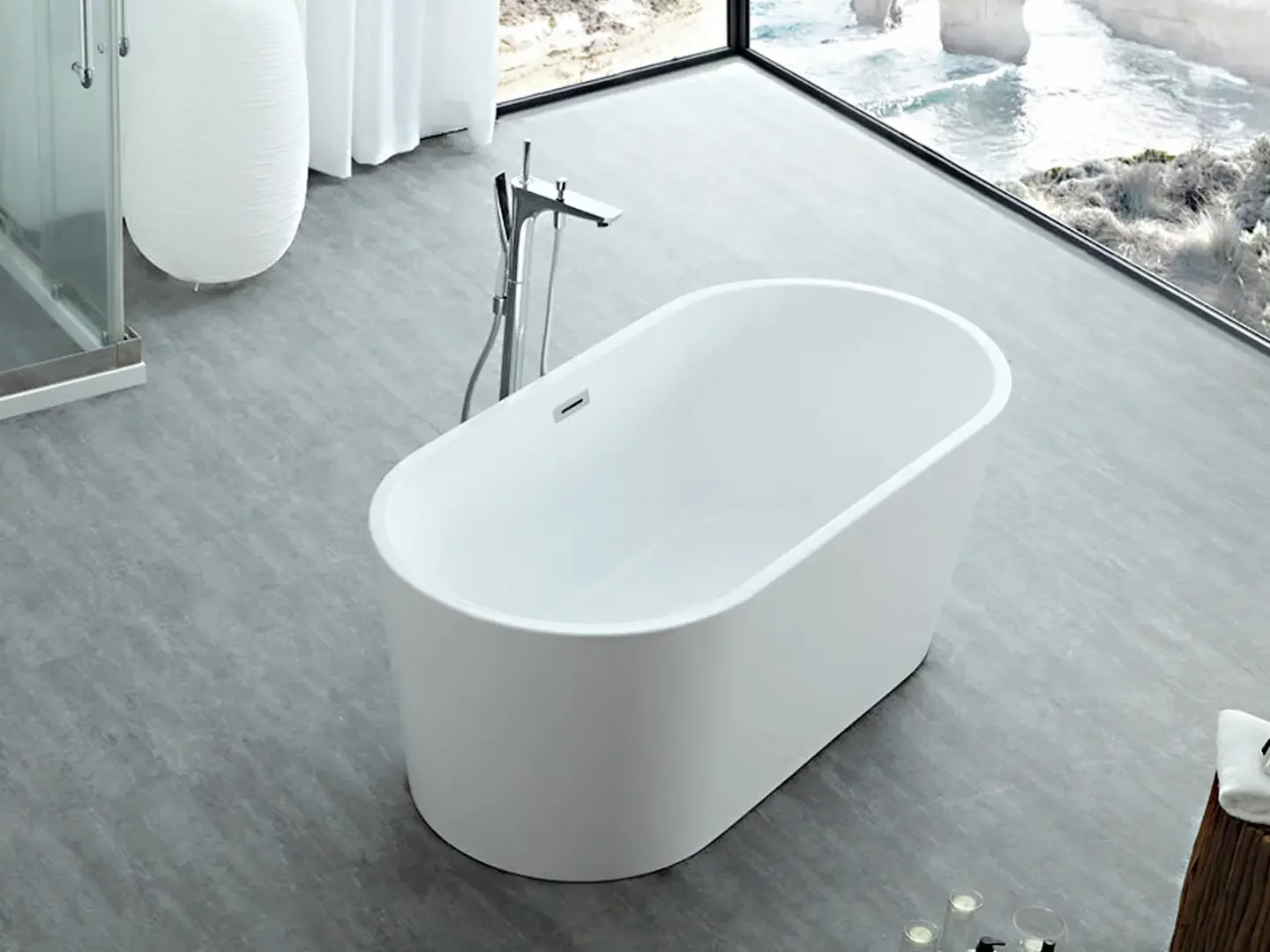
Bathtubs have evolved over time from being a built-in device in a room above wooden tubs to being an aesthetically pleasing “furniture” made of modern materials. One of the earliest preserved examples of what we understand by a bathtub is a painted approximately 1.5 m. long ceramic vessel found in Crete.
What we see today are bathtubs with or without integrated faucets and showers, made of acrylic, Solid Surface stone or other modern materials that suit a modern lifestyle.
Worth knowing about bathtubs
The SPA company's bathtubs are either made of acrylic or Solid Surface stone. They are available as freestanding tubs or tubs that are designed to be built-in, to be placed against a wall or in a corner. This provides an option that covers most needs. Some bathtubs have an integrated faucet with hand shower and diverter, and some are also available in a spa version with nozzles and possibly a heating element.
The SPA company has a large selection of well-designed bathtubs:
What constitutes quality in a bathtub?
The stand
A solid stand ensures that the tub stands firmly. SPA company bathtubs have stands with equal support points. All corners are supported with continuous bars that stand on the floor with adjustable legs. This provides a stable tub that does not tip. The corner supports also prevent the tub from giving way when filling with water.
Front panel
Some bathtubs are equipped with one or more front panels. All front panels are screwed to the frame. This prevents the panels from falling off prematurely, causing irritation and, in the worst case, damage. By loosening all the screws, easy access is provided for servicing the tub.
Drain
All drains are made of solid brass and the visible parts are chrome-plated. Compared to chrome-colored plastic, this gives a longer lifespan and a more solid appearance.
Integrated mixer tap
Some bathtubs have an integrated mixer tap. (See the product card for the individual product.)
In addition to being an aesthetically pleasing solution, it also has a hygienic side benefit, as the shower hose is hidden away and does not hang down inside the tub, where it can cause limescale deposits and soap residue to stick to the hose.
Bottom with space for drain hose
The tub shown is an acrylic bathtub, but the same applies to stone bathtubs.
The bottom of the tub has space for a drain cup or water trap to be installed under the tub.
Adjustable legs
The tub shown is a stone bathtub, but the same applies to all bathtubs.
The bathtubs are equipped with adjustable legs, which ensure that the tub also stands stably on a less even floor or in wadding; when there is a slight drop on the floor.
Solid Surface
Stone bathtubs are made from a composite material, often called Solid Surface, but also known by other names such as “composite” or “engineered stone”. However, the name composite is used for many other compositions that are composed, either by homogeneous mixing of the materials it is composed of, or by combining alternating layers of different materials. Reinforced concrete or fiberglass-reinforced plastic are examples of composite materials.
Solid Surface consists of powdered stone (usually bauxite or marble) that is pressed into a mold together with a binder (acrylic or polyester) and colorants.
The result is a homogeneous and non-porous material. This results in a surface that is easy to clean, and because it is homogeneous (same composition throughout), minor scratches can be easily polished away. Dyes in the starting product and the fineness of the powdered stone material mean that Solid Surface can be mistaken for natural stone.
Solid Surface is a material that allows for many ways to shape it. It can be cast into a mold, glued or welded together, giving the designer a wide range of possibilities that are difficult to achieve with natural stone. Since Solid Surface is homogeneous throughout, it also does not contain the weaknesses found in natural stone due to cracks and impurities.
Products cast in a mold do not have joints that can collect dirt and thus provide a breeding ground for bacteria and mold, which is why Solid Surface is hygienic in use.
Accessories
For bathtubs, there is a selection of accessories that cover drains and bottom valves for shower enclosures.
Most bathtubs come with a drain that does not have a water trap. If there is no water trap in the floor drain, the included drain can be replaced with one that has an integrated water trap.
If you combine the bathtub with a shower, it is a good idea to have a shower screen that is adapted to a bathtub. They are available in clear and frosted glass.
A little more technical…
Water supply
If there is an integrated faucet on the tub, the water is supplied with soft hoses. The water connection can be located on or in the wall up to 5 cm below the height of the tub.
Water pressure
Extra high water pressure is not required for a bathtub. A diverter determines whether the water comes out of either the hand shower or the tap. (See the model description on the product card.)
Location
Bathtubs must be placed in a water-proof room with a floor drain.
The drain
The drain can be placed anywhere under the tub. To ensure that there is room for a possible water trap, it is a good idea not to place the drain directly under the tub drain (See the drawing on the individual product).
Own control
Upon receipt, the customer must check that the packaging is intact and that the product has not been damaged during transport. Before installation, the installer must ensure that all hoses and cables are correctly positioned.
The drain hose is usually only mounted for transport and should be mounted and sealed so that the hose has the correct direction in relation to the floor drain.